 Add to Chrome
 Add to Firefox
 Add to Edge
Harmony in Diversity: Multi-domain Contrastive Policy Optimization for Large Reasoning Models
May 25, 2026
Post-training has significantly enhanced the reasoning capability of Large Reasoning Models (LRMs), especially with Reinforcement Learning (RL) like Group Relative Policy Optimization (GRPO). However, GRPO-style RL methods in multi-domain settings often fail to achieve consistent improvements across all domains due to inherent interference in policy optimization. Prior studies on multi-domain RL primarily focus on alleviating cross-domain interference, while often neglecting the pivotal role of knowledge sharing, which we argue is the key to transforming cross-domain interactions from harmful competition into beneficial transfer. To address this limitation, we propose Multi-domain Contrastive Policy Optimization (MCPO), which analyzes the structural relationships among rollouts and promotes cross-domain knowledge sharing and in-domain knowledge consolidation in a contrastive manner. Specifically, for a given prompt, MCPO identifies transferable reasoning trajectories from other domains as positive examples, while treating incorrect rollouts as negative ones. It then encourages consistent representations for positive pairs and pushes negative pairs apart, thereby facilitating knowledge transfer and reducing interference. Moreover, MCPO aligns intra-domain correct rollouts to build a consolidated representation space. In this way, MCPO contrastively learns a harmonious representation space that can accommodate diverse multi-domain knowledge. Empirical results show that MCPO improves the reasoning capabilities of LRMs across multiple domains and even outperforms single-domain training in some cases. Code is available at https://github.com/Maricalce/MCPO.

M$^4$-SAM: Multi-Modal Mixture-of-Experts with Memory-Augmented SAM for RGB-D Video Salient Object Detection
May 12, 2026The Segment Anything Model 2 (SAM2) has emerged as a foundation model for universal segmentation. Owing to its generalizable visual representations, SAM2 has been successfully applied to various downstream tasks. However, extending SAM2 to the RGB-D video salient object detection (RGB-D VSOD) task encounters three challenges including limited spatial modeling of linear LoRA, insufficient employment of SAM's multi-scale features, and dependence of initialization on explicit prompts. To address the issues, we present Multi-Modal Mixture-of-Experts with Memory-Augmented SAM (M$^4$-SAM), which equips SAM2 with modality-related PEFT, hierarchical feature fusion, and prompt-free memory initialization. Firstly, we inject Modality-Aware MoE-LORA, which employs convolutional experts to encode local spatial priors and introduces a modality dispatcher for efficient multi-modal fine-tuning, into SAM2's encoder. Secondly, we deploy Gated Multi-Level Feature Fusion, which hierarchically aggregates multi-scale encoder features with an adaptive gating mechanism, to balance spatial details and semantic context. Finally, to conduct zero-shot VSOD without manual prompts, we utilize a Pseudo-Guided Initialization, where a coarse mask is regarded as a pseudo prior and used to bootstrap the memory bank. Extensive experiments demonstrate that M$^4$-SAM achieves the state-of-the-art performance across all evaluation metrics on three public RGB-D VSOD datasets.
Bin~Wan,G2HFNet: GeoGran-Aware Hierarchical Feature Fusion Network for Salient Object Detection in Optical Remote Sensing Images
Mar 13, 2026Remote sensing images captured from aerial perspectives often exhibit significant scale variations and complex backgrounds, posing challenges for salient object detection (SOD). Existing methods typically extract multi-level features at a single scale using uniform attention mechanisms, leading to suboptimal representations and incomplete detection results. To address these issues, we propose a GeoGran-Aware Hierarchical Feature Fusion Network (G2HFNet) that fully exploits geometric and granular cues in optical remote sensing images. Specifically, G2HFNet adopts Swin Transformer as the backbone to extract multi-level features and integrates three key modules: the multi-scale detail enhancement (MDE) module to handle object scale variations and enrich fine details, the dual-branch geo-gran complementary (DGC) module to jointly capture fine-grained details and positional information in mid-level features, and the deep semantic perception (DSP) module to refine high-level positional cues via self-attention. Additionally, a local-global guidance fusion (LGF) module is introduced to replace traditional convolutions for effective multi-level feature integration. Extensive experiments demonstrate that G2HFNet achieves high-quality saliency maps and significantly improves detection performance in challenging remote sensing scenarios.
RSONet: Region-guided Selective Optimization Network for RGB-T Salient Object Detection
Mar 13, 2026This paper focuses on the inconsistency in salient regions between RGB and thermal images. To address this issue, we propose the Region-guided Selective Optimization Network for RGB-T Salient Object Detection, which consists of the region guidance stage and saliency generation stage. In the region guidance stage, three parallel branches with same encoder-decoder structure equipped with the context interaction (CI) module and spatial-aware fusion (SF) module are designed to generate the guidance maps which are leveraged to calculate similarity scores. Then, in the saliency generation stage, the selective optimization (SO) module fuses RGB and thermal features based on the previously obtained similarity values to mitigate the impact of inconsistent distribution of salient targets between the two modalities. After that, to generate high-quality detection result, the dense detail enhancement (DDE) module which adopts the multiple dense connections and visual state space blocks is applied to low-level features for optimizing the detail information. In addition, the mutual interaction semantic (MIS) module is placed in the high-level features to dig the location cues by the mutual fusion strategy. We conduct extensive experiments on the RGB-T dataset, and the results demonstrate that the proposed RSONet achieves competitive performance against 27 state-of-the-art SOD methods.
Mastering Negation: Boosting Grounding Models via Grouped Opposition-Based Learning
Mar 13, 2026Current vision-language detection and grounding models predominantly focus on prompts with positive semantics and often struggle to accurately interpret and ground complex expressions containing negative semantics. A key reason for this limitation is the lack of high-quality training data that explicitly captures discriminative negative samples and negation-aware language descriptions. To address this challenge, we introduce D-Negation, a new dataset that provides objects annotated with both positive and negative semantic descriptions. Building upon the observation that negation reasoning frequently appears in natural language, we further propose a grouped opposition-based learning framework that learns negation-aware representations from limited samples. Specifically, our method organizes opposing semantic descriptions from D-Negation into structured groups and formulates two complementary loss functions that encourage the model to reason about negation and semantic qualifiers. We integrate the proposed dataset and learning strategy into a state-of-the-art language-based grounding model. By fine-tuning fewer than 10 percent of the model parameters, our approach achieves improvements of up to 4.4 mAP and 5.7 mAP on positive and negative semantic evaluations, respectively. These results demonstrate that explicitly modeling negation semantics can substantially enhance the robustness and localization accuracy of vision-language grounding models.
RDNet: Region Proportion-Aware Dynamic Adaptive Salient Object Detection Network in Optical Remote Sensing Images
Mar 12, 2026Salient object detection (SOD) in remote sensing images faces significant challenges due to large variations in object sizes, the computational cost of self-attention mechanisms, and the limitations of CNN-based extractors in capturing global context and long-range dependencies. Existing methods that rely on fixed convolution kernels often struggle to adapt to diverse object scales, leading to detail loss or irrelevant feature aggregation. To address these issues, this work aims to enhance robustness to scale variations and achieve precise object localization. We propose the Region Proportion-Aware Dynamic Adaptive Salient Object Detection Network (RDNet), which replaces the CNN backbone with the SwinTransformer for global context modeling and introduces three key modules: (1) the Dynamic Adaptive Detail-aware (DAD) module, which applies varied convolution kernels guided by object region proportions; (2) the Frequency-matching Context Enhancement (FCE) module, which enriches contextual information through wavelet interactions and attention; and (3) the Region Proportion-aware Localization (RPL) module, which employs cross-attention to highlight semantic details and integrates a Proportion Guidance (PG) block to assist the DAD module. By combining these modules, RDNet achieves robustness against scale variations and accurate localization, delivering superior detection performance compared with state-of-the-art methods.
TCAP: Tri-Component Attention Profiling for Unsupervised Backdoor Detection in MLLM Fine-Tuning
Jan 29, 2026Fine-Tuning-as-a-Service (FTaaS) facilitates the customization of Multimodal Large Language Models (MLLMs) but introduces critical backdoor risks via poisoned data. Existing defenses either rely on supervised signals or fail to generalize across diverse trigger types and modalities. In this work, we uncover a universal backdoor fingerprint-attention allocation divergence-where poisoned samples disrupt the balanced attention distribution across three functional components: system instructions, vision inputs, and user textual queries, regardless of trigger morphology. Motivated by this insight, we propose Tri-Component Attention Profiling (TCAP), an unsupervised defense framework to filter backdoor samples. TCAP decomposes cross-modal attention maps into the three components, identifies trigger-responsive attention heads via Gaussian Mixture Model (GMM) statistical profiling, and isolates poisoned samples through EM-based vote aggregation. Extensive experiments across diverse MLLM architectures and attack methods demonstrate that TCAP achieves consistently strong performance, establishing it as a robust and practical backdoor defense in MLLMs.
OSDEnhancer: Taming Real-World Space-Time Video Super-Resolution with One-Step Diffusion
Jan 28, 2026Diffusion models (DMs) have demonstrated exceptional success in video super-resolution (VSR), showcasing a powerful capacity for generating fine-grained details. However, their potential for space-time video super-resolution (STVSR), which necessitates not only recovering realistic visual content from low-resolution to high-resolution but also improving the frame rate with coherent temporal dynamics, remains largely underexplored. Moreover, existing STVSR methods predominantly address spatiotemporal upsampling under simplified degradation assumptions, which often struggle in real-world scenarios with complex unknown degradations. Such a high demand for reconstruction fidelity and temporal consistency makes the development of a robust STVSR framework particularly non-trivial. To address these challenges, we propose OSDEnhancer, a novel framework that, to the best of our knowledge, represents the first method to achieve real-world STVSR through an efficient one-step diffusion process. OSDEnhancer initializes essential spatiotemporal structures through a linear pre-interpolation strategy and pivots on training temporal refinement and spatial enhancement mixture of experts (TR-SE MoE), which allows distinct expert pathways to progressively learn robust, specialized representations for temporal coherence and spatial detail, further collaboratively reinforcing each other during inference. A bidirectional deformable variational autoencoder (VAE) decoder is further introduced to perform recurrent spatiotemporal aggregation and propagation, enhancing cross-frame reconstruction fidelity. Experiments demonstrate that the proposed method achieves state-of-the-art performance while maintaining superior generalization capability in real-world scenarios.
Towards Ancient Plant Seed Classification: A Benchmark Dataset and Baseline Model
Dec 20, 2025Understanding the dietary preferences of ancient societies and their evolution across periods and regions is crucial for revealing human-environment interactions. Seeds, as important archaeological artifacts, represent a fundamental subject of archaeobotanical research. However, traditional studies rely heavily on expert knowledge, which is often time-consuming and inefficient. Intelligent analysis methods have made progress in various fields of archaeology, but there remains a research gap in data and methods in archaeobotany, especially in the classification task of ancient plant seeds. To address this, we construct the first Ancient Plant Seed Image Classification (APS) dataset. It contains 8,340 images from 17 genus- or species-level seed categories excavated from 18 archaeological sites across China. In addition, we design a framework specifically for the ancient plant seed classification task (APSNet), which introduces the scale feature (size) of seeds based on learning fine-grained information to guide the network in discovering key "evidence" for sufficient classification. Specifically, we design a Size Perception and Embedding (SPE) module in the encoder part to explicitly extract size information for the purpose of complementing fine-grained information. We propose an Asynchronous Decoupled Decoding (ADD) architecture based on traditional progressive learning to decode features from both channel and spatial perspectives, enabling efficient learning of discriminative features. In both quantitative and qualitative analyses, our approach surpasses existing state-of-the-art image classification methods, achieving an accuracy of 90.5%. This demonstrates that our work provides an effective tool for large-scale, systematic archaeological research.
SAM-DAQ: Segment Anything Model with Depth-guided Adaptive Queries for RGB-D Video Salient Object Detection
Nov 13, 2025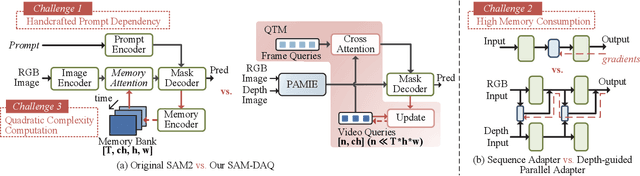
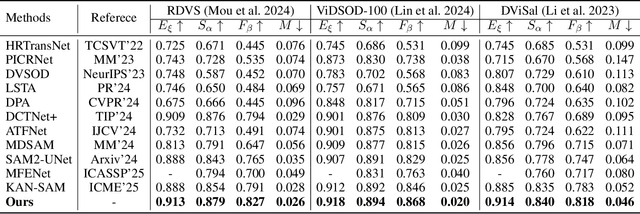
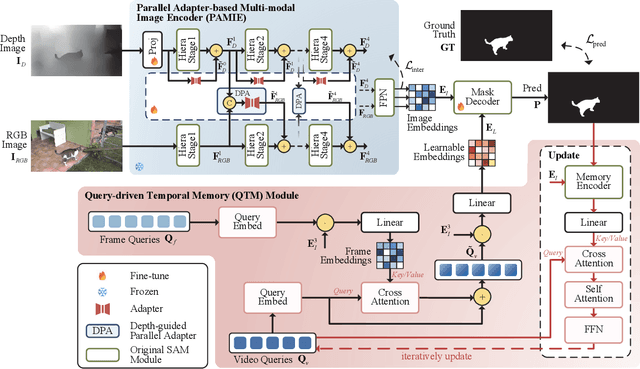
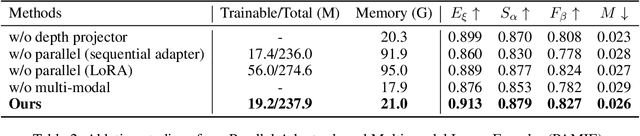
Recently segment anything model (SAM) has attracted widespread concerns, and it is often treated as a vision foundation model for universal segmentation. Some researchers have attempted to directly apply the foundation model to the RGB-D video salient object detection (RGB-D VSOD) task, which often encounters three challenges, including the dependence on manual prompts, the high memory consumption of sequential adapters, and the computational burden of memory attention. To address the limitations, we propose a novel method, namely Segment Anything Model with Depth-guided Adaptive Queries (SAM-DAQ), which adapts SAM2 to pop-out salient objects from videos by seamlessly integrating depth and temporal cues within a unified framework. Firstly, we deploy a parallel adapter-based multi-modal image encoder (PAMIE), which incorporates several depth-guided parallel adapters (DPAs) in a skip-connection way. Remarkably, we fine-tune the frozen SAM encoder under prompt-free conditions, where the DPA utilizes depth cues to facilitate the fusion of multi-modal features. Secondly, we deploy a query-driven temporal memory (QTM) module, which unifies the memory bank and prompt embeddings into a learnable pipeline. Concretely, by leveraging both frame-level queries and video-level queries simultaneously, the QTM module can not only selectively extract temporal consistency features but also iteratively update the temporal representations of the queries. Extensive experiments are conducted on three RGB-D VSOD datasets, and the results show that the proposed SAM-DAQ consistently outperforms state-of-the-art methods in terms of all evaluation metrics.